A grid trading EA opens a series of positions at set intervals as price moves against an initial entry, then closes the whole basket once combined profit hits a target. It's one of the oldest automated strategy structures on MetaTrader, and also one of the most misunderstood — mainly because "grid EA" covers everything from carefully risk-managed systems to uncontrolled martingale in disguise.
Fixed-pip grids vs. volatility-adaptive grids
The simplest grid EAs space new positions at a fixed number of pips, regardless of current market conditions. That's straightforward to configure but brittle: the spacing that works in a quiet range gets steamrolled the moment volatility expands, since positions stack up far faster than the strategy was designed for.
Adaptive grids solve this by tying spacing to a live volatility measure — typically ATR — so the distance between grid levels widens automatically when the market gets choppier and tightens when it calms down. This doesn't eliminate drawdown risk, but it keeps the grid's behavior roughly consistent across different market regimes instead of only working in the conditions it happened to be tuned on.
Percentage-based spacing for instruments other than forex
Grid EAs built for forex majors almost always use pips as the unit of measurement, which breaks down completely outside forex. A $20 stock and a $2,000 stock can't share the same fixed-point grid — the settings that make sense for one will either never trigger or trigger constantly on the other. Grid EAs designed for stocks or stock CFDs need percentage-based spacing instead, so the same configuration scales sensibly regardless of the underlying share price.
The risk controls that actually matter
Grid spacing gets most of the attention, but it's the risk-management layer around the grid that determines whether a bad stretch is survivable:
- Basket stop-loss — a hard ceiling on floating drawdown, in $ or % of balance, that closes the entire grid rather than letting it run indefinitely
- Lot progression — linear scaling adds risk predictably as the grid extends; exponential scaling recovers a losing basket faster but grows position size (and risk) much more aggressively
- A cap on maximum grid levels — an unbounded grid isn't really risk-managed, it's a bet that price reverses before the account runs out of margin
- Spread and cooldown filters, so the EA doesn't add positions during illiquid or erratic conditions
What to check before running one live
Look for a real max drawdown figure from a live account, not a backtest — grid strategies are notoriously easy to make look smooth in a backtest that never encountered a sustained trend. Confirm whether the EA has an explicit basket stop-loss (some don't, and rely purely on the grid eventually reverting). And size the account to the strategy's stated minimum deposit; grid EAs are more sensitive to under-capitalization than most other EA types, since a grid that runs out of room to add positions has fewer ways to recover.
Where Quantora fits
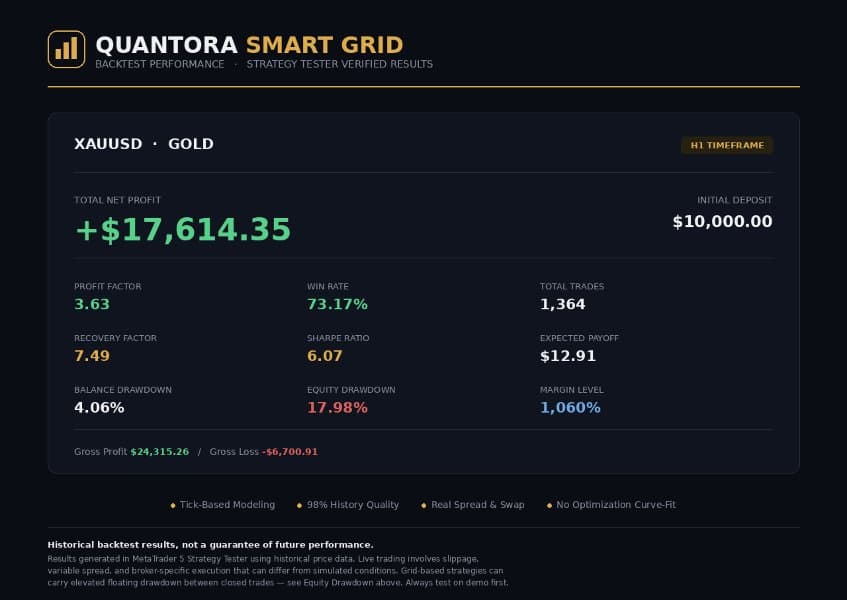
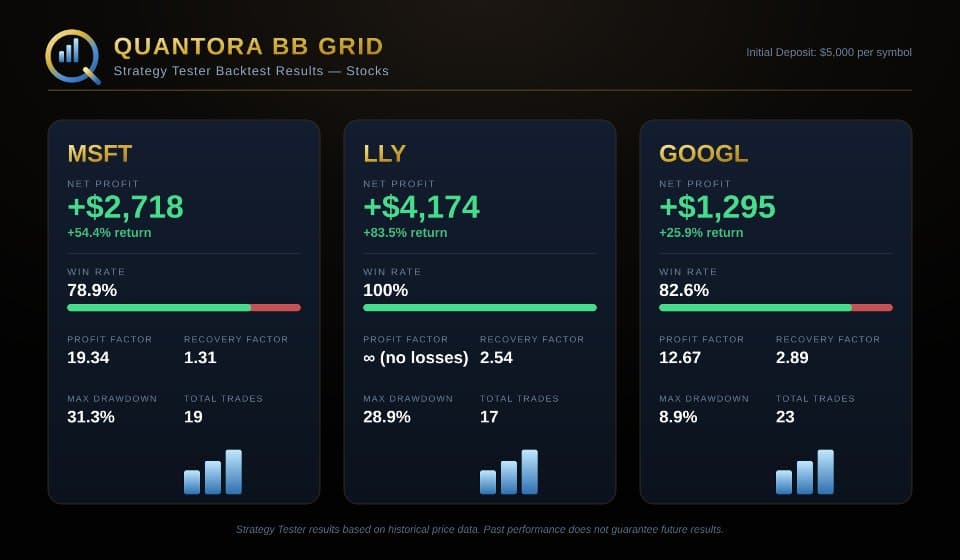
Quantora Smart Grid MT5 uses ATR-based adaptive spacing for XAUUSD with an optional basket stop-loss and a choice of linear or exponential lot progression. Quantora BB Grid MT5 applies the percentage-based approach described above, built specifically for individual stocks and stock CFDs with a swap-adjusted take-profit so long-held positions don't quietly lose their intended margin to overnight costs. Both publish live Myfxbook results rather than backtests alone.