A Fair Value Gap (FVG) is a three-candle price imbalance — a gap left behind when price moves fast enough that one candle's range doesn't overlap with the candles on either side of it. In Smart Money Concept (SMC) and ICT-style trading, these gaps are treated as zones price is statistically likely to revisit, since they represent inefficient price delivery that the market often "fills" later.
From FVG to IFVG: what "inversion" means
An Inverse Fair Value Gap happens when price returns to a Fair Value Gap and breaks all the way through it, rather than reacting and reversing at its edge. When that happens, the gap's role flips — a zone that previously acted as support can start acting as resistance, and vice versa. That inversion is the signal: it suggests the original imbalance has been invalidated and order flow has shifted direction.
This is a meaningfully different signal from a raw, un-inverted FVG. A plain FVG is a zone to watch; an IFVG is a zone that has already been tested and broken, which is why many price-action traders treat inversions as higher-conviction setups than the original gaps.
Why quality filtering matters more than detection
Detecting FVGs and their inversions programmatically is the easy part — any indicator can scan for three-candle imbalances and flag every one it finds. The problem is that on a busy chart, that produces dozens of signals a day, most of them low quality. What separates a useful IFVG indicator from a noisy one is the filtering layer on top: gap size relative to ATR, candle strength through the inversion, and how cleanly price broke through versus just wicking into it.
A tool that only flags the strongest, cleanest inversions will generate far fewer signals — but the ones it does show are worth paying attention to.
Using IFVG signals for entries, stops, and targets
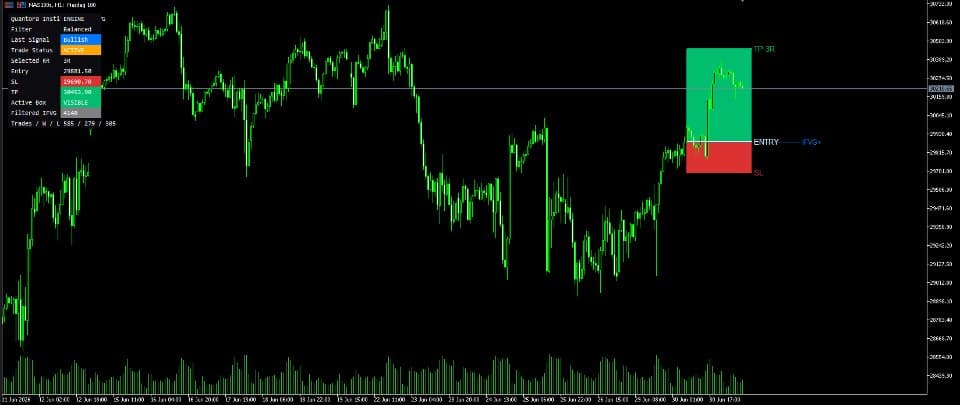
Once an inversion is confirmed, the gap itself gives you a natural structure for a trade: entry near the retest of the inverted zone, stop-loss beyond the gap's far edge, and take-profit sized as a multiple of that risk (commonly expressed as 1R to 6R). This is one of the reasons IFVG has become popular among discretionary SMC/ICT traders and systematic traders alike — the setup defines its own risk without needing a separate indicator for stop placement.
Where Quantora fits
Quantora Institutional IFVG automates the detection-and-filtering process described above: it identifies FVGs, tracks their inversion into IFVGs, and applies ATR- and candle-strength-based quality filters (Loose, Balanced, Strict, or fully custom) before plotting Entry, Stop Loss, and Take Profit levels with configurable Risk-to-Reward targets. It's built for Forex, Gold, Indices, and Crypto on H1/H4/Daily timeframes, with a free demo available on its MQL5 listing.